
FACT-Web (Free Access)
You can experience a limited selection of FactSage features for free on FACT-Web. No user registration is required, allowing you to start using it immediately.
[Notice] Please be aware that calculation results from FACT-Web should be used with caution for research or commercial applications. The user interface, setup screens, and operation methods differ significantly from the commercial version, and it only utilizes a limited database.
We encourage you to try Equilib-Web (equilibrium calculations for pure substances) and Phase Diagram-Web (phase diagram generation and single-point equilibrium calculations), which are among the most frequently used FactSage features.
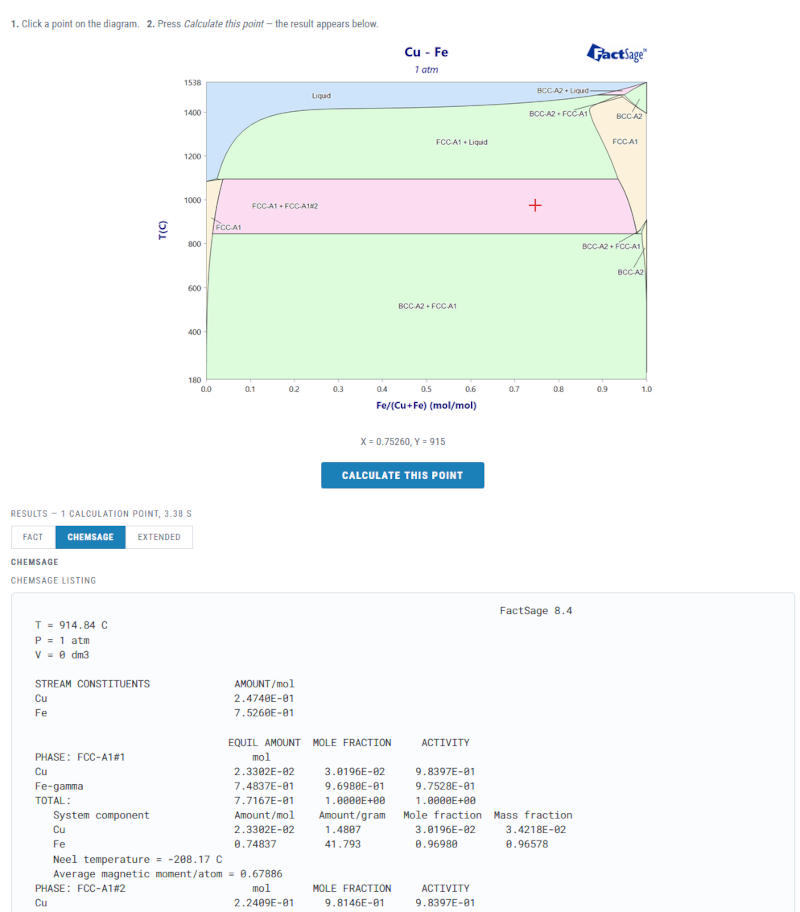
Phase Diagram-Web: Running an equilibrium calculation by clicking on the phase diagram
Exercises
Note: For all the exercises below, assume a pressure of 1 atm.
[Exercise 1] At 25 °C, H2O exists as a liquid (H2O(liquid)), and at 125 °C, it turns into a gas (H2O(gas)). What happens to H2O at 2500 °C? Does it remain as H2O(gas), or does it undergo a different change? Use Equilib-Web to predict the outcome.
[Exercise 2] You may remember from middle school chemistry that heating sodium bicarbonate (NaHCO3) causes it to decompose into sodium carbonate (Na2CO3), carbon dioxide (CO2), and H2O. If 1 gram of NaHCO3 is heated to 120 °C, how many grams of Na2CO3 will be produced? Furthermore, will Na2CO3 decompose if the temperature is raised even higher? Use Equilib-Web to predict the behavior.
[Exercise 3] Dissolving 0.004 mol of calcium hydroxide (Ca(OH)2) into 55.508 mol (approximately 1 kg) of H2O at 25 °C creates a dilute limewater solution. What is the pH of this solution? If you react this limewater with 0.01 mol of carbon dioxide (CO2), calcium carbonate (CaCO3) will precipitate. How many moles of CaCO3 will precipitate? If you add another 0.01 mol of CO2 (making a total of 0.02 mol), will the amount of precipitate increase? Use Aqualib-Web (designed for equilibrium calculations of dilute aqueous solutions) to predict the results.
[Exercise 4] By examining the phase diagram for the molar composition of 0.3 SiO2 + 0.1 CaO + 0.6 Al2O3 at 1600 °C, you will find it located within a region where liquid slag (liquid phase), mullite (solid phase), and Al2O3 (solid phase) coexist. Use Phase Diagram-Web to estimate the amount of substance (in moles) for Al2O3. (Note: Since you cannot specify exact composition values in Phase Diagram-Web, please use an approximate composition.)
